
From Oct 10 to 18, the China Foundation for Human Rights Development organized a nine-day media tour to Jilin province, bringing together more than 30 influential content creators and journalists from home and abroad to experience the vitality and unique charm of the region's revitalization in the new era.
Themed "Perceiving Happy China — Jilin Tour," the visit took participants through six cities and regions — Changchun, Songyuan, Liaoyuan, Tonghua, Baishan, and the Changbai Mountains — weaving together culture, industry, and ecology into a multifaceted portrait of a province on the rise.
For the delegation, it was a journey of discovery that unlocked Jilin's "code of happiness" layer by layer and brought together domestic and international voices to tell the story of high-quality development in northeast China.
.jpg)
Echoes of history
The Jilin Provincial Modern History Exhibition greets visitors with more than 300 years of regional history, told through photographs, artifacts and data charts that touch on Emperor Kangxi's eastern tour, Wu Dacheng's border demarcation and defense of territorial integrity, the September 18 Incident, the Northeast Anti-Japanese United Army, the Four Battles of Siping, and the "Three Lands and Three Cradles" — Jilin's revolutionary identity as a key base for the Northeast liberation war, the anti-Japanese resistance and the War to Resist U.S. Aggression and Aid Korea.
"I have never understood Jilin so completely and systematically before," said a member of the delegation, summing up the group's mood.
Critch, a British journalist with China Media Group's (CMG) English department, lingered at the exhibits. "China has endured great suffering, yet has achieved rapid development today. Such a nation commands respect," he said.
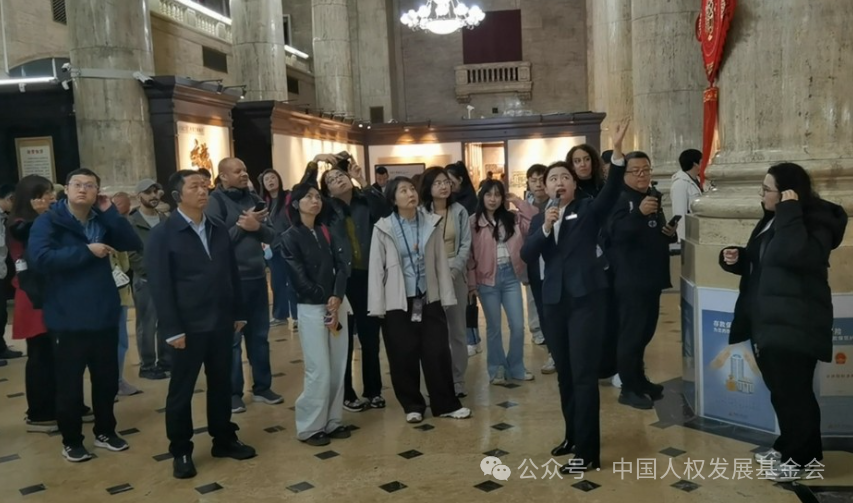
The weight of history did not fade when the group left the hall. At the Liaoyuan Miners' Grave Memorial Hall from the period of Japan's occupation of northeast China, rusted mining lamps and silent tombstones spoke of a painful past. At the former site of a World War II Allied senior prisoners-of-war camp, yellowed diaries and preserved barracks gave visitors a tangible sense of the anti-fascist struggle.
"The remains here are just the tip of the iceberg. Many more perished in suffering," said Tom, an American journalist with Xinhua News Agency. Critch added, "Through these exhibits, I have truly come to understand that period of history."
.jpg)
While the city's painful history leaves a lasting impression, Changchun's cinematic heritage reveals its rich artistic legacy. The Former Site Museum of Changchun Film Studio — the cradle of China's film industry — is filled with vintage projectors and props that retrace the birth and growth of Chinese cinema.
.jpg)
"This place not only records the history of Chinese cinema's development, but also shows the charm of film as a universal art form," said Zola, a Turkish reporter with CMG's Asia-Africa Center.
The Soviet Red Army Martyrs Memorial Tower, the dignified facade of the former central bank of the puppet Manchukuo regime, and the historic buildings along Xinmin Street all carry layers of memory, yet feel fully woven into the city today.
Turning further back in time, the delegation encountered the ancient Koguryo culture, a UNESCO World Heritage Site. At the Ji'an City Museum, gilded ornaments and the flowing lines of tomb murals sketched the contours of an ancient civilization. The Wandu Mountain City fortress snaked along mountain ridges, while the pyramid-like stone structure of the General’s Tomb and the thousand-year-old inscriptions on the Haotaiwang Stele kept the memory of the Koguryo kingdom alive.
"These relics I saw in Ji'an are truly impressive. When I return home, I will share them with people around me," said Junaid Mohammed, a host with Pakistan's GEO TV.
.jpg.png)
Intangible heritage, meanwhile, gave the group a chance to take part rather than look on. At a heritage showcase in Songyuan, folk musicians and dancers pulled visitors into a circle of music and motion. In the Naoheya community, they tried paper-cutting and the horse-head fiddle alongside residents. At the Dingrun Cultural Industrial Park, a dazzling array of heritage products showed traditional crafts alive and well in modern Jilin.
.jpg)
Lin Shuqi, a reporter with Shenzhen Satellite TV's Direct News, said she was particularly charmed as a southerner. "In the future, I will do more to promote Jilin's local traditional culture to the outside world," she said.
Industrial transformation: tradition meets innovation
No visit to Jilin is complete without ginseng, the so-called "king of herbs." At the Ginseng Exchange Center in Wanliang town, Fusong county, nearly 300 varieties of ginseng products from more than 3,000 merchants lined the shelves. Zola picked up product after product with undisguised enthusiasm and ended up joining the buying queue.
Li Muzi, a reporter with Zhejiang Daily's Tide News, said the visit gave her a deep understanding of ginseng culture and useful tips for picking a good root. The nearby Wanliang Changbai Mountain Wild Ginseng Exhibition Hall boasts a collection of ginseng specimens of various ages, including rare specimens that have been growing for decades. Critch posed for a photo beside one venerable root, giving an enthusiastic thumbs-up.
From the soil to the assembly line, the tour moved on to Jilin's other signature industry: automobiles. At the Jiefang J7 smart manufacturing plant and the NBD headquarters of China FAW Group Co., Ltd. in Changchun, automated lines ran at full speed as intelligent robots and mechanical arms went about their work, and finished vehicles rolled off the line.
"It's not just the highly intelligent workshops — you can clearly feel the company's deep-rooted innovation-driven philosophy. From production details to R&D, every part of the place is impressive," said @UncleGoodThings, a popular online influencer.
.jpg.png)
Mei Yiling, an Italian editor and host with China Daily, settled into one of the finished cars and ran her hand along the interior. "The feel of this car is really premium, and the design is very refined," she said.
In Liaoyuan, the delegation found a different kind of industry tour. At the Liuhe Deer Industry Pastoral Complex in Dongfeng county, sika deer blinked soft eyes from their pens as the fresh smell of earth filled the air. At Beifang Hosiery Group, the group saw the technology behind Liaoyuan's title as "China's Cotton Sock Capital." At Jinyi Egg Products Co., Ltd., smart production lines turned eggs into yolk powder, egg white powder and braised eggs — a textbook case of "whole-egg utilization." And at the Dongfeng County Edible Fungi Integration Demonstration Park, button mushrooms turned out to be grown from straw, cow dung and other agricultural "waste," a vivid example of the circular economy at work.
"From whole-chain egg processing to circular mushroom cultivation, from deer pastures to a technology-empowered industrial park, the delegation saw what high-quality development actually looks like on the ground in northeast China," wrote Wang Sihao, a reporter with People's Daily.
Harmony of nature and humanity
As the highest peak in northeast Asia and the "roof of northeast China," Changbai Mountain is the most dramatic window onto the province's natural wealth. At the Changbai Mountain Natural Museum, the group took in the mountain's geological evolution and the wonders of this "ecological treasure house."
Standing at the foot of the mountain, gazing up at the peaks, touching century-old trees and listening to birdsong, the visit delivered on every expectation.
"I had heard of Changbai Mountain's beauty before, but coming here, I was deeply moved by its grandeur," said Chen Yuehan, a journalist with the China Internet Information Center. With the Shenyang-Baishan high-speed railway now open, she added, travel from Beijing has never been easier. "I sincerely recommend that friends from across the country come and experience this natural beauty for themselves," she said.
.jpg)
In golden October, Chagan Lake lived up to its name: a sheet of glass, its banks brushed with red and gold, water birds skimming the surface and leaving faint ripples behind. The group pulled out phones, posed for selfies and tried to capture the moment.
While strolling along the shore, Martial, a foreign reporter with CMG's Asia-Africa Center Persian department, came across a praying mantis. Cradling it carefully in his hand, he reflected: "To see small creatures living and breeding freely by the lake tells you just how good the environment is here."
It was, in miniature, the story of Jilin today: a place where old industry is being reinvented, old crafts are being passed on, and a centuries-old landscape is being protected rather than paved over.
The mix of nature and culture continued at the Geological Museum of Jilin University, with its towering dinosaur skeleton and glittering mineral specimens, and at the Huang Danian Memorial Hall, where visitors learned about the geophysicist who returned from abroad to teach and inspire a generation of Chinese scientists.
.jpg.png)
As the itinerary drew to a close, the group was in no hurry to leave.
"During these days in Jilin, what impressed me most was the beautiful scenery and hospitality," said Yang Xiaoshu, a journalist with CMG's Asia-Africa Center. "I want to recommend it to all my colleagues and friends — Jilin truly has so many treasures."
Lin Shuqi said the trip had given her far more than scenery. "Although the weather was a bit cold, the hospitality made me feel very much at home," she said.
"I want to stay in Jilin. It is simply too beautiful," said Zola, who added that she hoped to return with her family one day.
From the weight of history to the hum of automated factories, from the warmth of folk music to the stillness of ancient pines, the delegation's nine days in Jilin added up to something larger than a tour. Grounded in history, built on industry and alive with nature, the province is opening itself up to the world — and, by the look on the journalists' faces, the world is paying attention.